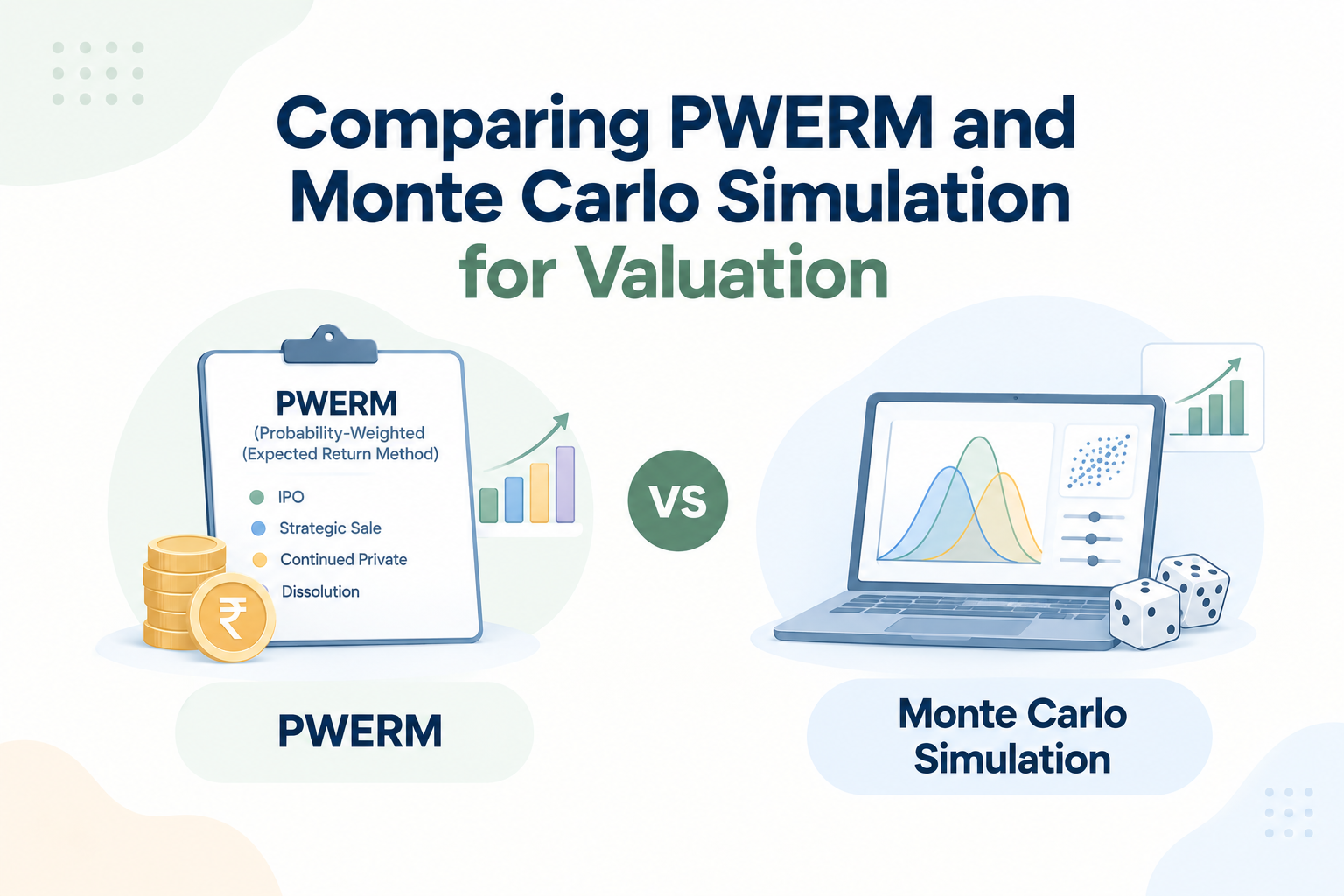
Comparing PWERM and Monte Carlo Simulation for Valuation
Valuing a private company becomes more challenging when there is no clear single outcome for the future. A company could raise additional funding, be acquired, go public, or continue operating privately. Each outcome can lead to a different value for shareholders.
Two methods commonly used to deal with this uncertainty are the Probability-Weighted Expected Return Method (PWERM) and Monte Carlo Simulation.
Both methods address the same problem: future outcomes are uncertain, and a single valuation scenario may not capture that uncertainty. The main difference is how they model it. PWERM uses a small number of defined scenarios, while Monte Carlo Simulation models thousands of possible outcomes using probability distributions.
Where Are PWERM and Monte Carlo Used?
Both approaches are commonly used in private company equity valuation, particularly when a company has preferred shares, stock options, warrants, convertible securities, or other instruments with different economic rights.
They can be relevant for:
- 409A valuations and ESOP pricing
- Financial reporting valuations
- Allocating equity value among different share classes
- Valuing complex capital structures
- Determining the value of common stock when preferred investors have liquidation preferences
In these situations, the value of each security can change significantly depending on the company's eventual exit value and how proceeds are distributed among shareholders.
How Does PWERM Work?
The Probability-Weighted Expected Return Method (PWERM) considers a limited number of possible future scenarios.
For example, a valuation might consider an IPO, a strategic acquisition, continued operation as a private company, or a downside scenario such as liquidation. For each scenario, the valuer estimates the expected exit value, probability of the outcome, and timing of the event.
The company's proceeds are then allocated among different securities based on their contractual rights, including liquidation preferences and conversion features. The resulting value for each class is discounted back to the valuation date and weighted according to the probability assigned to each scenario.
Why Use PWERM?
The biggest advantage of PWERM is transparency.
A board, auditor, investor, or management team can see which scenarios were considered and how each one affects the valuation. This makes PWERM particularly useful when a company is approaching a likely liquidity event and the possible outcomes are reasonably identifiable.
The main challenge is that scenario probabilities involve judgment. If the probability assigned to an acquisition or IPO changes significantly, the resulting equity value can also change substantially.
How Does Monte Carlo Simulation Work?
Monte Carlo Simulation takes a different approach. Instead of selecting a few specific scenarios, it generates thousands of possible outcomes based on probability distributions for key assumptions.
Depending on the valuation, these assumptions may include:
- Exit equity value
- Time to exit
- Share price volatility
- Correlations between variables
- Other factors affecting the company's capital structure
Each simulated outcome is passed through the company's equity waterfall to determine how much each class of security would receive.
After thousands of simulations, the model produces a distribution of possible results. The expected value can then be used as an indication of the security's value.
Why Use Monte Carlo?
Monte Carlo is particularly useful when a security has complex or non-linear economic features.
It can be useful for analysing instruments involving performance-based vesting, milestone-triggered conversions, ratchets, participating preferred shares, or conversion thresholds and caps.
These features can be difficult to represent accurately using only a few fixed scenarios.
Key Differences Between PWERM and Monte Carlo
The biggest difference is how each method represents uncertainty.
PWERM uses discrete scenarios. The valuer decides which outcomes are most relevant and assigns a probability to each one. This makes the model relatively easy to explain and review.
Monte Carlo uses probability distributions. Instead of deciding on a handful of outcomes, the model generates a large number of possible results. This provides a broader view of potential outcomes but requires more assumptions and modelling.
PWERM is generally easier for management, boards, and auditors to understand because each scenario can be reviewed individually. Monte Carlo models can be more difficult to explain because the final result comes from thousands of simulated outcomes.
The data requirements also differ. PWERM relies heavily on assumptions about scenario probabilities and exit values. Monte Carlo requires inputs such as volatility, probability distributions, and correlations, which often need market data or comparable-company evidence.
In terms of complexity, Monte Carlo is generally better suited to securities with non-linear or path-dependent payoffs, while PWERM works well when the likely outcomes are relatively straightforward.
Common Pitfalls
PWERM's biggest weakness is subjective scenario probabilities. Probabilities should not simply be selected to produce a desired valuation. They should be supported by factors such as the company's stage, funding position, investor expectations, market conditions, and the likelihood of a transaction.
Monte Carlo has a different risk: false precision.
Running thousands of simulations does not automatically make a valuation more accurate. If the assumptions about volatility, correlations, exit values, or time to exit are weak, the model can produce a very precise-looking result that is still unreliable.
Both methods also require careful consideration of the discount rate, expected exit value, and any applicable discount for lack of marketability.
Which Method Should You Use?
There is no universal answer. The appropriate method depends on the company's circumstances and the characteristics of the security being valued.
PWERM may be more appropriate when:
- A near-term exit is reasonably foreseeable.
- The number of likely outcomes is limited.
- Management and investors have a clear view of potential scenarios.
- Transparency is particularly important for board or audit discussions.
Monte Carlo may be more appropriate when:
- There are many possible future outcomes.
- The company has complex securities.
- The payoff depends on thresholds, volatility, or other non-linear factors.
- A small number of scenarios cannot adequately represent the economics.
A hybrid approach can also be appropriate. For example, a valuation may use defined scenarios for a likely near-term exit while applying an option-based or simulation-based approach to a continued-private scenario.
PWERM and Monte Carlo Simulation are different ways of dealing with uncertainty in private company valuation.
PWERM provides a clear, scenario-based view and works well when future outcomes can be reasonably identified. Monte Carlo provides a broader range of possible outcomes and is particularly useful when the securities or exit economics are too complex to capture through a handful of scenarios.
The right choice depends on the company's stage, capital structure, available data, and the complexity of the securities being valued.
Most importantly, a sophisticated model cannot compensate for weak assumptions. Whether a valuation uses PWERM, Monte Carlo, or a combination of both, the reliability of the result ultimately depends on the quality of the inputs and the evidence supporting them.