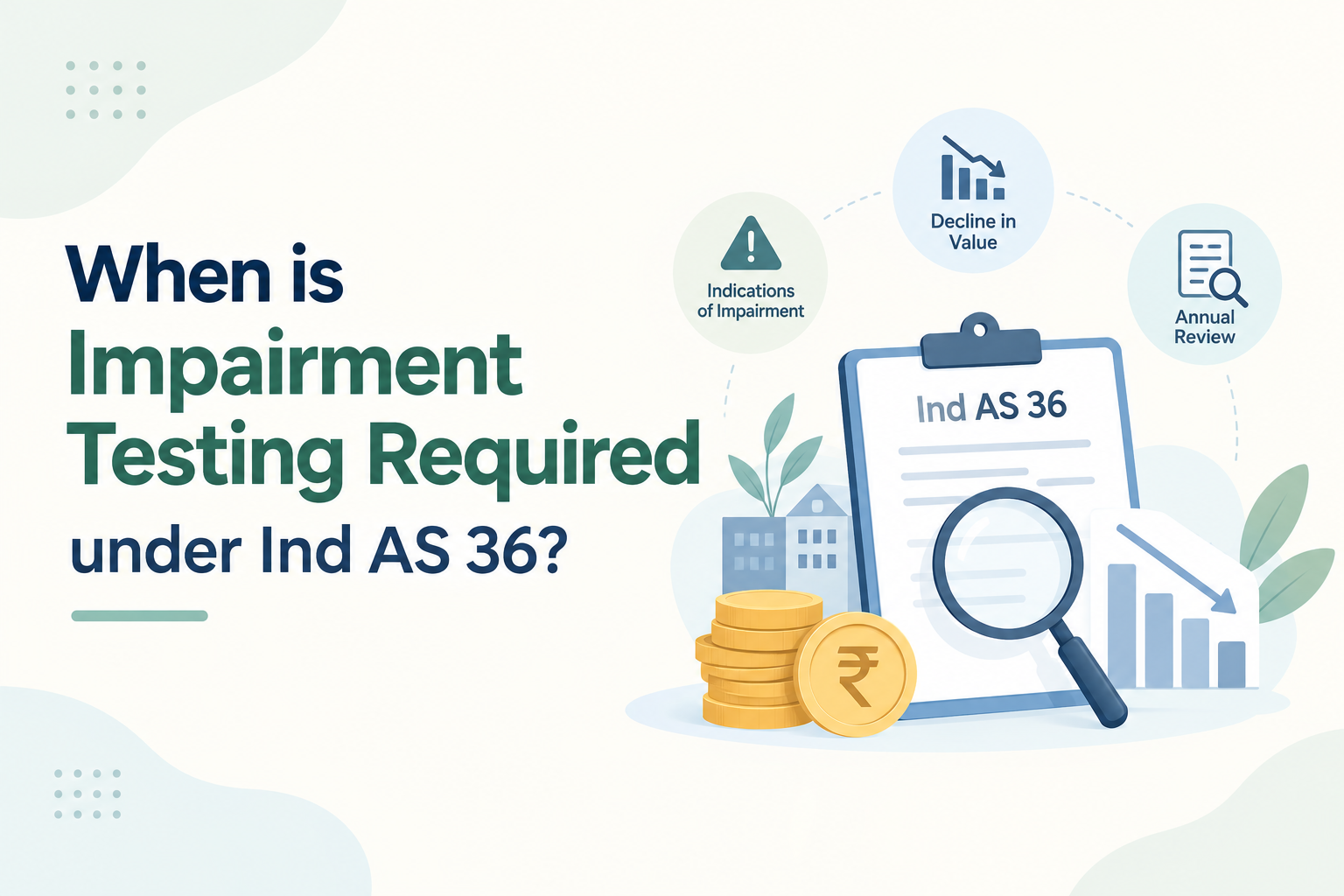
When is impairment testing required under Ind AS 36?
Ind AS 36 is designed to make sure assets are not shown in the balance sheet at more than their recoverable value. But that does not mean every asset has to be formally tested for impairment every year.
The standard takes a more practical approach. Some assets must be tested annually, whether or not there is any sign of impairment. For other assets, a formal impairment test is required only when there is an indication that the asset may have lost value. Knowing which category an asset falls into can save time and help avoid issues during an audit.
An asset is impaired when its carrying amount is higher than its recoverable amount.
Recoverable amount is the higher of:
- Fair value less costs of disposal: The amount the company could receive from selling the asset, after deducting the costs of disposal.
- Value in use: The present value of the future cash flows expected to come from using the asset.
If the carrying amount is higher than the recoverable amount, the difference is recognised as an impairment loss.
Situation 1: Assets That Require Annual Testing
Certain assets must be tested for impairment at least once a year, even when there is no obvious indication that they have lost value.
These include:
- Goodwill acquired through a business combination
- Intangible assets with an indefinite useful life
- Intangible assets that are not yet available for use, such as a product still under development
The reason is fairly straightforward. These assets either are not being amortised in the normal way or have not yet started generating the benefits expected from them. An annual test helps ensure that their carrying amounts remain supportable.
The annual impairment test can be performed at any point during the year, as long as it is carried out at roughly the same time each year. Different assets or cash-generating units (CGUs) can have different testing dates.
If an intangible asset is recognised during the year but is not yet available for use, it should be tested for impairment before the end of that year.
Situation 2: Testing When There Is an Indication of Impairment
For other assets, such as property, plant and equipment, amortised intangible assets and right-of-use assets, an annual impairment test is not automatically required.
Instead, the company needs to assess at each reporting date whether there is any indication that the asset may be impaired.
If there is an indication, the company estimates the asset's recoverable amount and determines whether an impairment loss needs to be recognised. If there is no indication, a formal impairment test is generally not required.
Of course, goodwill and the assets that require annual testing must still be tested if an impairment indicator appears during the year.
What Counts as an Impairment Indicator?
Ind AS 36 provides examples of impairment indicators, but the list is not exhaustive. Companies still need to apply judgment based on their circumstances.
External indicators
These can include:
- A significant decline in the asset's market value
- Negative changes in technology, markets, the economy or applicable laws
- An increase in market interest rates that could increase the discount rate used in the valuation
- The company's net assets being higher than its market capitalisation
Internal indicators
Internal signs can include:
- Evidence that an asset has become obsolete or physically damaged
- An asset becoming idle or plans to discontinue, restructure or dispose of a business or operation
- Actual financial performance being worse than expected, such as lower cash flows or higher operating losses
Should You Test an Individual Asset or a CGU?
Not every asset generates cash inflows independently.
If an asset does not generate largely independent cash flows, it is generally tested as part of a cash-generating unit (CGU). A CGU is the smallest identifiable group of assets that generates cash inflows that are largely independent of those from other assets.
Goodwill is allocated to the CGUs, or groups of CGUs, that are expected to benefit from the business combination. The impairment test is then performed at that level.
What Happens After an Impairment Test?
If an impairment loss is identified for a CGU, the loss is first allocated to any goodwill assigned to that unit. Any remaining loss is then allocated to the other assets of the unit on a pro rata basis, subject to the applicable limits.
An impairment loss recognised for an asset other than goodwill can be reversed in a later period if the estimates used to determine recoverable amount improve.
Goodwill is different. An impairment loss recognised for goodwill cannot be reversed.
The basic rule is simple:
Test goodwill, indefinite-life intangible assets and intangible assets not yet available for use at least once a year. For other assets, assess at every reporting date whether there are indicators of impairment. Even when you conclude that no indicators exist, keep a clear record of what you considered and why.
If an indicator does arise, carry out the impairment assessment promptly rather than waiting for the annual reporting process. Ind AS requirements and related interpretations can change, and impairment assessments often involve significant judgment. For a specific situation, it is worth confirming the current requirements with your auditor or accounting adviser.